
Research across 400 companies reveals something uncomfortable: poor communication isn't just frustrating. It's haemorrhaging productivity at a rate of $1.2 trillion annually across U.S. businesses alone.
For individual employees, unclear instructions cost 40 minutes per day. That's £26,000 per person per year in lost productivity.
But here's what the research doesn't tell you: the problem isn't that people communicate badly.
The problem is that most of us don't realise we're not actually communicating at all.
We're transmitting words whilst assuming shared meaning. We're speaking in deletions, distortions, and generalisations, then acting surprised when execution collapses.
What the Meta Model Actually Is
The Meta Model isn't a communication technique.
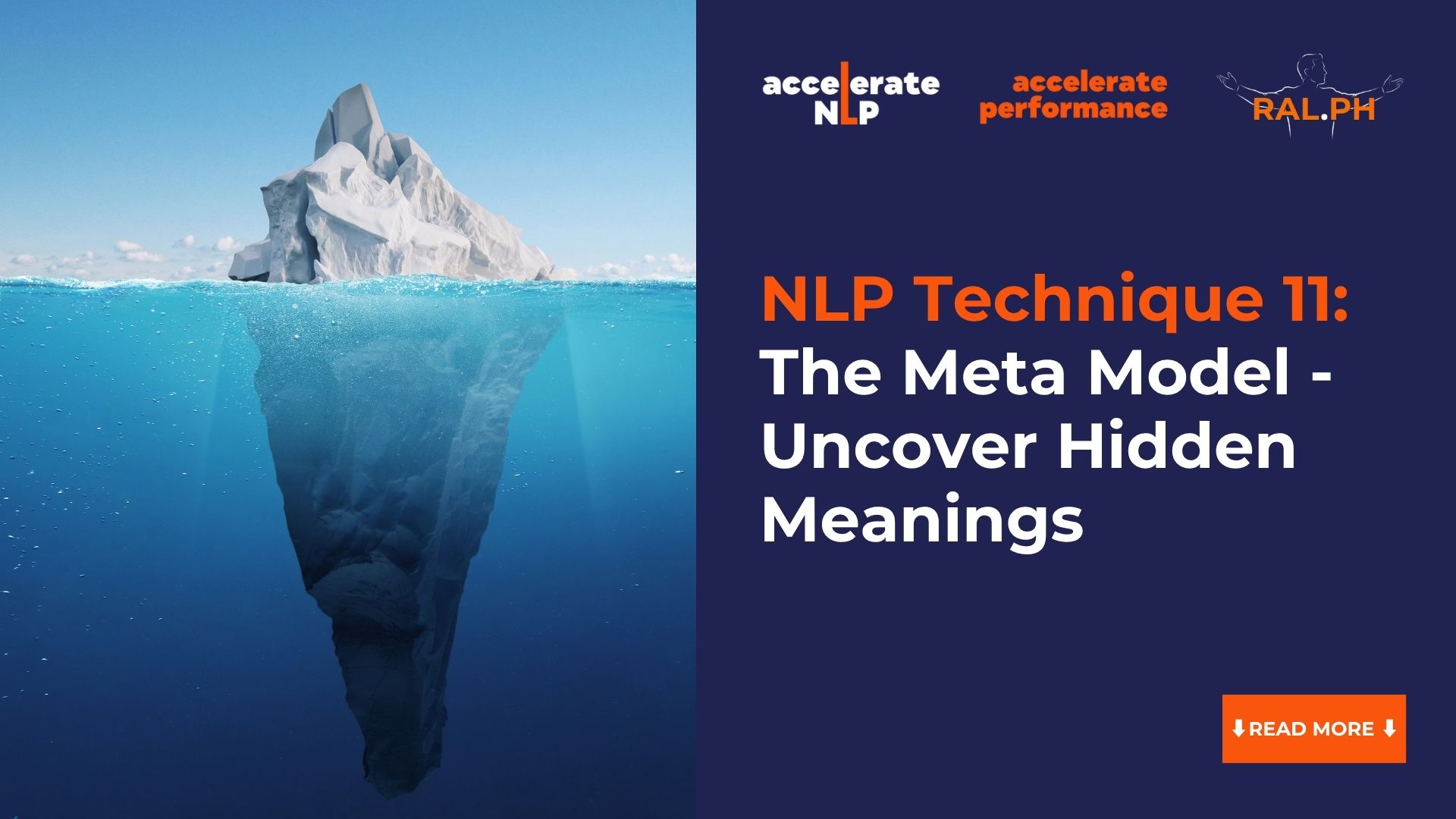
It's a diagnostic framework that exposes the structural gaps between what someone says and what they actually mean.
Developed in the 1970s by Richard Bandler and John Grinder as part of Neuro-Linguistic Programming, the Meta Model identifies three core patterns that create what academics call "noise in communication":
Deletions: Information left out entirely
Distortions: Facts twisted through interpretation
Generalisations: Specific experiences turned into universal rules
These aren't occasional errors. They're how human brains process language by default.
Your executive team isn't being deliberately vague when they say "we need to transform the business" or "the client wants changes." They genuinely believe they've communicated something meaningful.
They haven't.
The Business Jargon Trap
Walk into any boardroom and you'll hear it within minutes.
"We need to leverage our capabilities."
"Let's synergise across departments."
"This will drive stakeholder alignment."
These phrases create the feeling of competence without actually clarifying anything. They're linguistic camouflage for unconscious incompetence.
I've watched entire strategy sessions collapse because no one asked the obvious question: "What specifically do you mean by that?"
The Meta Model gives you permission to ask that question. More importantly, it gives you the structure to ask it in a way that surfaces clarity rather than defensiveness.
How Precision Questioning Actually Works
Here's what most people miss about the Meta Model: it's not about being pedantic.
It's about isolating the constraint.
When someone on your leadership team says "they don't care," you're not challenging them to win an argument. You're restoring the deleted information that determines whether you can actually solve the problem.
The question sequence looks like this:
"Who specifically doesn't care?"
"How do you know they don't care?"
"What would caring look like in measurable terms?"
Three questions. Thirty seconds. The difference between executing on assumption and executing on reality.
Research on precision questioning shows that leaders who systematically uncover details through targeted questions make right decisions more often than wrong ones. They create highly productive environments because decisions become clear rather than contested.
This isn't theoretical. I've used this exact sequence to prevent a six-figure project derailment because "the client wants changes" turned out to mean "one stakeholder mentioned a preference in passing."
The Three Patterns That Sabotage Execution
Pattern One: Unspecified Nouns
"Management doesn't support this initiative."
Which members of management? The CFO who controls budget allocation? The COO who oversees implementation? The CEO who mentioned it once in passing?
Until you know who specifically, you're shadow-boxing.
Pattern Two: Unspecified Verbs
"We need to improve customer experience."
Improve how? Faster response times? Better product quality? More personalised communication? Different pricing structure?
Vague verbs create the illusion of alignment whilst guaranteeing misaligned execution.
Pattern Three: Universal Quantifiers
"Everyone knows this won't work."
"We always struggle with this."
"Nobody takes this seriously."
Always? Everyone? Never? Really?
These generalisations shut down possibility before you've even diagnosed the actual constraint. One exception disproves the universal rule, which means the rule was never accurate to begin with.
Why Smart Leaders Still Get This Wrong
I've coached C-suite executives who can dissect a P&L in minutes but can't spot a deletion in their own strategy narrative.
It's not an intelligence problem. It's a pattern recognition problem.
Your brain evolved to process language efficiently, not accurately. It fills gaps automatically, interprets ambiguity based on past experience, and generalises to conserve cognitive resources.
This works brilliantly for survival. It's catastrophic for organisational execution.
The executives I work with don't need motivation. They need a diagnostic framework that exposes what their pattern recognition system is missing.
That's what the Meta Model provides.
The Implementation Gap Nobody Talks About
Here's where most communication training fails: it treats the Meta Model as a list of questions to memorise.
That's like handing someone a surgical scalpel and calling them a surgeon.
The Meta Model becomes powerful when you understand which pattern you're addressing and why it matters in context.
When a board member says "this strategy won't work," you need to know whether you're dealing with a deletion (missing information about why), a distortion (interpretation masquerading as fact), or a generalisation (one failed attempt extrapolated to all future attempts).
Each requires a different intervention.
This is why I don't just teach the Meta Model. I embed it into live business contexts where the stakes are real and the ambiguity is expensive.
What Changes When You Actually Apply This
The impact isn't subtle.
Meetings that used to circle for 90 minutes reach executable conclusions in 20. Strategy documents that generated confusion now generate aligned action. Feedback that used to land as criticism now lands as clarity.
One client reduced project scope creep by 60% in a quarter. Not through better project management tools. Through better questions at the requirements stage.
Another eliminated three layers of unnecessary approval process because we identified that "senior sign-off is required" actually meant "one director mentioned this preference two years ago and nobody questioned it since."
The financial impact is measurable. Research shows that managers who provide regular, constructive feedback see 14.9% lower turnover rates. Teams with clear communication show 12.5% greater productivity.
But the deeper shift is structural: you stop accepting vague language as normal.
The Questions That Change Everything
You don't need to memorise a script. You need to internalise three diagnostic questions that work in virtually any business context:
"Who or what specifically?"
Restores deleted nouns. Turns "management" into "the CFO and COO." Turns "the market" into "enterprise clients in financial services."
"How exactly?"
Clarifies vague verbs. Turns "improve performance" into "reduce customer response time from 48 hours to 24 hours."
"Always? Everyone? Never?"
Challenges generalisations. Turns "this never works" into "we tried this approach twice in 2019 and it didn't work then."
Three questions. Infinite applications.
Why This Isn't Just About Communication
The Meta Model does something more valuable than improving conversations.
It upgrades how leaders think.
When you habitually restore deleted information, challenge distortions, and test generalisations, you're not just communicating more clearly. You're making better decisions faster.
Academic research confirms that questioning has long been linked to strong leadership. Leaders who see themselves as learners and actively seek to understand others' perspectives through inquiry develop shared meaning and enable participation.
Both are vital for leading change.
Yet most leaders still default to advocacy over inquiry. They put forward arguments and impose views rather than asking questions that surface what's actually true.
The Meta Model reverses that default.
The Real Barrier to Implementation
I'll be direct: most people won't use this.
Not because it doesn't work. Because it requires something uncomfortable: the willingness to surface what's actually unclear rather than pretending shared understanding exists.
Asking "who specifically?" in a board meeting feels confrontational until you realise that proceeding without clarity is far more expensive than momentary discomfort.
The leaders who implement this successfully share one trait: they value accuracy over comfort.
They'd rather know the truth now than discover it six months into failed execution.
What to Do Next
Start with one pattern. Pick the one that shows up most often in your context.
If your team constantly uses vague nouns ("they," "management," "the market"), spend one week restoring specificity. Every time you hear an unspecified noun, ask "who or what specifically?"
If your strategy documents are full of impressive-sounding verbs that mean nothing ("leverage," "optimise," "transform"), spend one week clarifying action. Every time you see a vague verb, ask "how exactly?"
If your leadership team operates on generalisations ("this always fails," "nobody wants this"), spend one week testing universal claims. Every time you hear "always," "never," "everyone," or "nobody," ask for the exception.
One pattern. One week. Watch what shifts.
The Meta Model isn't a communication technique you add to your toolkit.
It's a diagnostic framework that changes how you process information.
And once you see the patterns, you can't unsee them.
That's when real transformation begins.
Final Thought
Want to embed this capability across your leadership team? The Meta Model is one component of the NLP frameworks I teach executives who are done with surface-level communication training. If you're ready to upgrade how your organisation thinks and decides, let's talk about what that looks like in your context.