

People can freeze or be in a stuck place because two equally valid parts of themselves are pulling in opposite directions.
One part wants to hold the team accountable. Another part wants to protect morale. One part knows the strategic pivot is necessary. Another part fears destabilising what's already working. One part pushes for the promotion. Another part questions whether the cost to personal life is worth it.
This isn't weakness. It's the natural result of being a thinking human with competing priorities.
But here's what most leadership development gets wrong: it treats inner conflict as something to overcome through willpower or ignore through positive thinking.
That approach doesn't resolve the tension. It just teaches you to suppress one side until it resurfaces later, usually at the worst possible moment.
What actually works is integration.
The Neuroscience of Why We Fight Ourselves
Your brain doesn't experience inner conflict as abstract philosophy. It registers as genuine threat.
Research using fMRI imaging shows that when you're caught between competing desires, your amygdala lights up. The same neural architecture that responds to external danger activates when you're internally divided.
Your nervous system can't distinguish between "I'm being chased by a predator" and "Part of me wants to take this risk whilst another part wants to play it safe."
Both trigger the same stress response.
But here's the fascinating part: simply labelling the conflict begins to calm that threat response. The act of naming what's happening shifts the experience from reactive emotion to manageable challenge.
That's not pop psychology. That's measurable neurological change.
When you identify and name the competing parts, you move the processing from your amygdala to your prefrontal cortex. You shift from fight-or-flight into strategic thinking.
This is why people who learn to work with their inner conflicts rather than against them make faster decisions and recover more easily from errors.
They're not suppressing valid concerns. They're integrating them into a more sophisticated operating system.
What NLP Calls 'Parts'
In Neuro-Linguistic Programming, we use the term 'Parts' to describe these internal positions.
Not because you're actually fragmented, but because it's a useful model for understanding how different aspects of your psychology can hold conflicting intentions.
Think of it this way: you're the CEO of your own decision-making apparatus. Different departments have different mandates. Your risk management function wants to protect what you've built. Your growth function wants to expand into new territory. Your relationship function wants to maintain connection. Your achievement function wants to push harder.
None of these functions are wrong.
The problem emerges when they're not talking to each other, when they're operating as competing silos rather than integrated parts of a coherent strategy.
The gym versus couch scenario is the simplest example. One part of you genuinely wants the health benefits, the energy, the sense of accomplishment. Another part genuinely wants rest, recovery, the comfort of not pushing.
Both have positive intentions.
This is the critical insight that changes everything: every part of you is ultimately trying to achieve something beneficial. Even the part that seems self-sabotaging has a function it's trying to fulfil.
The part that procrastinates? It might be protecting you from the vulnerability of putting imperfect work into the world. The part that overcommits? It might be trying to secure belonging through usefulness. The part that avoids difficult conversations? It's probably trying to maintain relational safety.
When you understand this, the whole game changes.
You're no longer fighting yourself. You're negotiating between legitimate stakeholders who want compatible outcomes but have different strategies for getting there.
The Parts Integration Technique
Here's how you actually resolve the conflict.
This isn't theory. This is the precise process I use with people who need to make high-stakes decisions whilst managing competing internal pressures.
Step 1: Identify the Conflict
Name the two parts clearly.
Not vaguely. Not as "I'm conflicted about this decision." Specifically.
"Part of me wants to fire this underperforming team member. Part of me wants to give them another chance."
"Part of me wants to pursue this ambitious growth target. Part of me wants to consolidate what we've already achieved."
"Part of me wants to take the promotion. Part of me wants to protect my current work-life balance."
The clarity matters. Vague awareness of tension doesn't create the conditions for resolution. Precise identification does.
Step 2: Visualise Each Part
This is where it gets interesting.
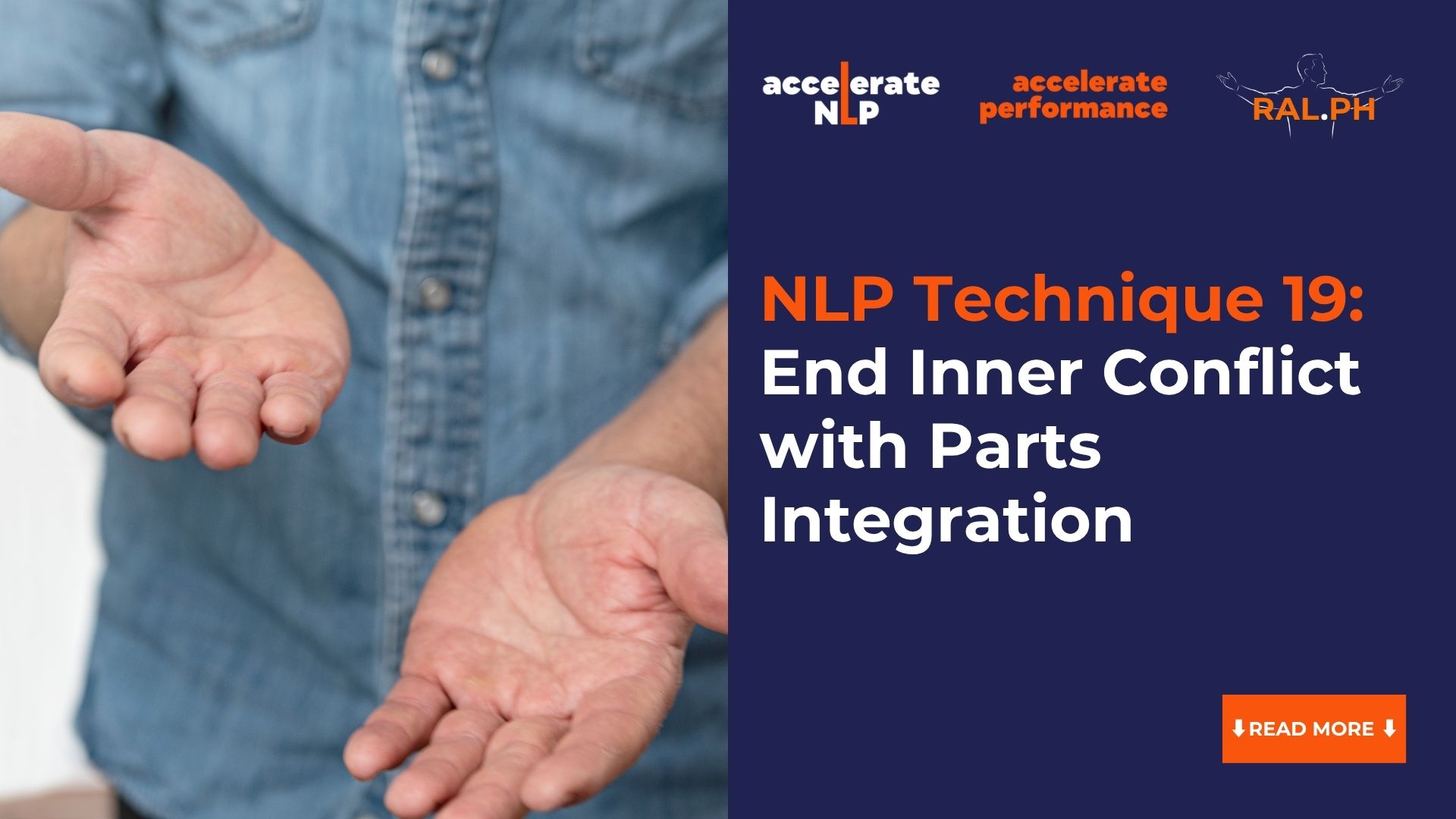
Hold your hands out in front of you, palms up. Imagine one part in your left hand, the other in your right.
Yes, this feels strange the first time. Do it anyway.
Now give each part a representation. Some people see images. Some sense qualities like weight or temperature. Some just have a knowing of what each part represents.
There's no right way to do this. Your neurology will give you whatever representation is most useful.
What matters is that you're externalising the internal. You're creating enough distance from the conflict to examine it rather than being consumed by it.
Step 3: Discover the Positive Intention
This is where most people have the breakthrough.
Ask each part: "What are you trying to do for me? What's your positive intention?"
The part that wants to stay on the couch might say "I'm trying to give you rest so you don't burn out." The part that wants to go to the gym might say "I'm trying to give you energy and health so you can perform at your best."
Notice something?
Both parts want you to feel good and perform well. They just have different strategies.
This pattern holds across virtually every internal conflict. When you dig beneath the surface behaviour to the underlying intention, you discover that the supposedly opposing parts are actually trying to achieve compatible outcomes.
The part that wants to hold your team accountable and the part that wants to protect morale? Both want a high-performing team that delivers results sustainably.
The part that wants to take risks and the part that wants stability? Both want you to succeed without unnecessary loss.
The highest intentions are either identical or compatible.
Step 4: Facilitate the Negotiation
Now you let the parts talk to each other.
Ask each part: "Can you see that the other part is also trying to help? Can you recognise that you both want the same ultimate outcome?"
This isn't about forcing agreement. It's about creating the conditions for genuine recognition.
When the part that wants rest recognises that the part wanting exercise also cares about your wellbeing, something shifts. When the part that wants growth recognises that the part wanting stability is trying to protect what you've built, the opposition dissolves.
You're not choosing between them anymore. You're finding the integrated strategy that honours both intentions.
Step 5: The Integration
This is the physical anchor that makes the shift concrete.
Slowly bring your hands together. As you do, imagine the two parts merging, combining their resources, creating something new that has the strengths of both.
What emerges isn't a compromise where both parts lose something. It's a synthesis where both parts contribute to a more sophisticated solution.
The integrated part might say: "I'll go to the gym three times a week in a way that actually energises me, and I'll genuinely rest on the other days without guilt."
That's not the gym part winning or the rest part winning. That's both parts getting what they actually wanted: sustainable high performance.
When your hands come fully together, bring them to your chest. Let the integrated part settle into your body, into your operating system.
You've just upgraded your internal decision-making architecture.
Why This Works When Other Approaches Don't
Most conflict resolution strategies, internal or external, operate on a win-lose model.
You pick a side. You override the objection. You push through the resistance.
That creates temporary movement, but the unresolved part doesn't disappear. It goes underground and resurfaces later, often with more force.
Parts Integration works because it operates on a fundamentally different principle: every part of you is an asset when properly integrated.
The part that hesitates isn't your enemy. It's your risk assessment function. The part that pushes isn't reckless. It's your growth engine.
When you integrate them, you get careful expansion. Strategic risk-taking. Growth that doesn't destroy what you've built.
Research on psychological integration confirms this. People with integrated parts are more congruent, make clearer decisions, take more constructive action, and report greater overall wellbeing.
This isn't about feeling good. It's about performing better.
A leader with unintegrated parts wastes energy on internal negotiation that should be directed at external execution. Every decision becomes a battle. Every choice carries residual doubt.
A leader with integrated parts moves faster, decides with less second-guessing, and executes with the full force of their capability behind the action.
The Broader Application
I use this technique with executives facing decisions that matter.
The founder deciding whether to raise capital or bootstrap. The executive choosing between competing strategic directions. The leader navigating the tension between short-term results and long-term capability building.
These aren't simple choices with obvious right answers. They're genuine dilemmas where intelligent people can legitimately argue both sides.
The reason they're dilemmas is because both sides have merit.
Parts Integration doesn't eliminate the complexity. It transforms how you hold it.
Instead of being paralysed by competing valid perspectives, you integrate them into a more nuanced strategy that honours the wisdom in both positions.
You stop fighting yourself and start leveraging your full intelligence.
The technique also scales beyond individual decisions. I've used variations of this process with leadership teams experiencing strategic conflict, with boards navigating governance tensions, with partnerships managing competing visions.
The pattern holds: when you surface the positive intentions beneath the surface positions, you usually discover compatible goals being pursued through different strategies.
Integration becomes possible.
What Integration Actually Feels Like
You'll know the integration worked because the internal argument stops.
Not because you've suppressed one side. Because you genuinely don't experience them as opposing anymore.
The decision that felt impossible becomes straightforward. Not easy, necessarily, but clear.
You move from "I don't know what to do" to "I know what to do, and I know why I'm doing it this way."
That clarity is the marker of genuine integration.
There's also a somatic shift. The physical tension that accompanies inner conflict dissolves. Your breathing deepens. Your shoulders drop. You feel more solid, more present, more whole.
This isn't metaphorical. Psychological integration produces measurable physiological changes.
When your internal system aligns, your nervous system registers safety. You're no longer under threat from yourself.
The Practice
Like any capability, this gets stronger with use.
The first time you run the process, it might feel mechanical. You're learning the steps, getting familiar with the structure.
The fifth time, it becomes more fluid. You start recognising the patterns in your own conflicts.
The twentieth time, it's part of how you think. You catch yourself in internal opposition and immediately start looking for the positive intentions.
Eventually, integration happens faster. You don't need the full formal process every time. Your neurology learns the pattern and starts running it automatically.
But you have to start somewhere.
Pick a current conflict. Something real, something that matters, but not your highest-stakes decision whilst you're still learning the technique.
Run the process. See what happens.
Most people are surprised by how quickly the shift occurs when you actually do the exercise rather than just thinking about it.
The difference between intellectual understanding and experiential integration is the difference between knowing about a tool and being able to use it under pressure.
Stop Fighting Yourself
You have better things to do with your energy than wage internal wars.
Every hour you spend paralysed by competing internal voices is an hour you're not spending building what you're here to build.
Parts Integration isn't about eliminating complexity or pretending difficult decisions are easy.
It's about transforming how you navigate that complexity. Moving from fragmented opposition to integrated capability.
When your parts work together instead of against each other, you access a level of performance that simply isn't available when you're internally divided.
You make better decisions. You execute with more commitment. You recover faster when things don't go as planned.
Because you're operating as a unified system rather than a collection of competing agendas.
That's not just inner peace. That's competitive advantage.
Try the technique. Find out what becomes possible when you stop fighting yourself and start integrating your full intelligence into every decision.
The parts you've been treating as obstacles might turn out to be exactly the resources you need.